66 million have NOTHING in Emergency Savings
Having a 6 month emergency savings nest is harder for some generations. According to a new survey from www.BankRate.com, 66 million Americans do not have emergency savings. 1/3 of Americans ages 36-51 years old (Gen X) have savings. Only 27% of other Americans of all ages have anything saved up.
It is very important to have an emergency savings account of 6 months of liquid cash so that in the event of an emergency such as losing your job, medical bills, or auto maintenance you will be covered. But only an astonishing 28% of all Americans, according to the new survey, have put aside any savings into this emergency fund of 6 months of expenses. The silver lining, if there is one? That percentage has risen by 6% from one year ago. Furthermore, nearly half of Americans older than 71 years old have enough savings for six months of living expenses.
Millennials (ages 18 through 34) have the same saving habits as Gen Xers, with 2/3 reporting at least some savings. The 1/3 without savings should check out ways to save by eliminating debt and alternative money making methods.
It may be difficult for millennials to save when they are in low-paying jobs and have crippling student loans. According to the study, half of the Americans with annual incomes of 75K or more have emergency savings, while more than half of Americans with incomes of less than 30k have nothing saved. One way to combat this is to check out the Millennial Money Guide, which teaches you ways to combat debt and save up for an emergency fund regardless of your income. While saving for an emergency fund competes with saving for retirement, paying off loans, rent, car payments, and all the expenses you incur every month it still is possible.
It is not your salary that makes your rich, it is your spending habits.
-Charles. A. Jaffe
The overall picture appears to be improving, however. June marks the 25th consecutive month that Americans’ financial security has improved, with men reporting more security for the 28th straight month. Women have reported increasing financial security in 16 of 28 months including eight of the past 12. Sites such as MillennialMoneyGuide.com provide guidance and financial clarity for those who need it. It is no longer the day and age where you need a financial adviser, with the internet you can gather the help you need. If you have any financial questions feel free to contact me. I am always happy to help and utilize my experience in the field of money to help out fellow young adults and millennials. Contact me here: admin@millennialmoneyguide.com
Brian is 25 years old and is the founder of Millennial Money Guide, a financial blog aimed to help millennials battle student loans and plan for retirement. When he’s not blogging, he can be found working out or traveling. If you want to learn more about how to become debt free you can email admin@millennialmoneyguide.com
DISCLAIMER
Next Generation Trust Services LLC/Next Generation TS, LLC does not evaluate, recommend, warrant, guarantee, or endorse the legality, propriety, performance, or reliability of any investment, service, statement, opinion, or other representation of any professional listed in our service providers network; carry any liability in any event for any misinformation, misrepresentation, negligence, act, omission, investment results, or wrongdoing of any professional network service provider; have any agreement or arrangement with any professional service provider with regard to any investment or service that may be provided to NGTS account owners or other investors; have any financial arrangement or affiliation with any professional network service provider.

Don’t Hit the Brexit Stock Market Panic Button!
The vote by the populace of the United Kingdom to exit the European Union had world markets all atwitter immediately afterwards. What will happen to world currencies? What about people’s retirement plans?
An article in the New York Times last week gave smart advice to investors about the stock market, where many people have been putting money away for their retirement. The author’s response to the Brexit anxiety: don’t do anything. This is especially true for investors whose portfolios are heavy into stocks, which are long-term investment vehicles (he suggests riding it out).
That said, self-directed investors are less likely to be exposed to the market volatility that those in stocks and bonds are feeling now, and are likely to feel throughout the shakeup and transition that Brexit will bring. This is because, rather than relying solely on the restricted menu of stocks, bonds, and mutual funds allowed in typical plans, self-directed retirement plans may include different types of alternative assets. Even if the stock market is bouncing around or market volatility increases over the foreseeable future, a self-directed IRA can weather the storm of EU breakups, thanks to its diverse mix of assets.
Instead of succumbing to post-Brexit-vote panic and making a knee-jerk investment  move right now, consider a retirement strategy that includes nontraditional investments—real estate (domestic or foreign), commodities, precious metals, hedge funds, loans, private placements, and lots more. Given the stress that investing in stocks inflicts on so many people (look at all the life savings that were lost in the Great Recession), you can step away from that panic button by including alternative assets you already know and understand in a self-directed IRA.
As the name implies, with self-direction you control your retirement plan by directing your portfolio and making your own investment decisions. The administrator (like Next Generation Trust Services) executes the transactions, holds the assets, and manages all the required paperwork and reporting. Our helpful white paper explains it all to you and our video series walks you through various aspects of opening an account. Our professionals at Next Generation Trust Services are available to answer your questions about self-directed investments, help you open your account, and provide transaction support. Want to know more? Contact us at Info@NextGenerationTrust.com or 888.857.8058.
Eight Must Know Terms for Retirement
Does financial jargon give you a headache? Do the terms associated with retirement plans sound like a bunch of mumbo-jumbo? Relax … here’s a quick primer on retirement plan terms that you need to know, especially if you are a younger worker about to start funding your plan. (If so, good for you!)
1. Defined Benefit Plan
This is an employer-sponsored retirement plan in which your company would pay a regular (“defined”) benefit to you after you retire—either a specified monthly dollar amount or a figure based on a calculation (factors include your earnings history and years of service at the company). The defined benefit plan may require you to contribute to it or not. Pension plans are defined benefit plans but they are starting to disappear from the employee benefits landscape.
2. Defined Contribution Plan
The word “contribution” signals that the employee contributes funds into this employer-sponsored retirement plan; the employer may also make contributions on your behalf. The employer will offer you some options for how you’d like to invest the money. Your retirement savings amount is predicated upon your contribution level and the kinds of returns the investments yield.
3. 401(k)
Among defined contribution plans, one of the most popular is a 401(k). Your company may offer you two varieties to pick from:
A traditional 401(k) – you contribute pretax dollars from your paycheck. The pretax contributions help lower your taxable income, and any earnings in your account are tax-deferred (funds grow tax free until withdrawal).
A Roth 401(k) – you can contribute on an after-tax basis. You pay taxes up front on your contributions but the money or any earnings you withdraw in retirement are tax-free income.
There are contribution limits for the 401(k) plans. For 2016, employees under 50 years old can contribute up to $18,000, (regardless of the type of plan you have). Employees 50 years old and up can also make additional catch-up contributions of up to $6,000, for a maximum contribution of $24,000.
Universities, the government and nonprofit organizations have a different version of these plans, the 403(b) or 457 plan.
4. Match
This refers to matching contributions your employer may opt to make to your account. This can really help boost your retirement savings. Matching contributions often occur with 401(k) plans, as a certain percentage of your contribution, up to a certain amount of your salary.
5. IRA
IRA stands for Individual Retirement Arrangement or Individual Retirement Account. You open and fund this on your own. You may choose to open a Traditional or a Roth IRA.
IRAs have much lower contribution limits than 401(k) plan: up to $5,500 in 2016, with the catchup contribution of $1,000 allowed for individuals who are 50 and older.
6. Target Date Fund
There is a type of mutual fund called a target date fund; the types of investments this fund includes will change over time, as you near the target date. In other words, the investing strategy of a target date fund (also known as an age-based fund or lifecycle fund) is matched to a specific timeframe (hence, target date). Target date funds of younger workers will likely include riskier investments; funds of older workers nearing retirement age will shift allocations to more conservative, low-risk investments.
7. Rollover
We’ve written about rollovers before and even have a video that explains rollovers and transfers, which are different ways to fund a new 401(k) or IRA. With a rollover, you roll funds over from an existing retirement plan to a new plan of the same type. It might be after you leave one job that had a 401(k); if your new company offers a 401(k), you can roll the funds over from the old to the new. It’s an easy way to keep all your retirement savings in one place.
8. Self-Direction
Now this a term that we like to hear at Next Generation Trust Services! Self-direction is a great way to build retirement savings for certain savvy investors who like to take charge of their investments and are comfortable making their own investment decisions. People who self-direct their retirement plans can include a broad range of alternative assets in their plans that are not allowed in typical IRAs or 401(k) plans. For example, a self-directed retirement plan can include precious metals, commodities, real estate, secured or unsecured loans, and many other non-publicly traded assets. For example, do you already invest in rental property? Include it in a self-directed IRA. Want to purchase shares in a rubber tree plantation? Have your self-directed retirement plan make the investment.
Self-directed investors work with administrators (like Next Generation) who manage all the paperwork and mandatory reporting, execute the transactions (upon instructions from the client), and provide transaction support. It’s up to the individual to fully research and understand the target investment—as administrators, we do not offer investment advice. However, we do offer education about self-direction as a retirement strategy, and review all transactions to ensure our clients are investing according to IRS guidelines.
Want to know more about self-directed IRAs or 401(k) plans? You can download this informative white paper to read more; then contact us at Info@NextGenerationTrust.com or 888.857.8058 with any questions or to open your new self-directed retirement account.
Our CEO, Jaime Raskulinecz, Has Done it Again as a Leading Woman Entrepreneur!
Jaime Raskulinecz, founder and CEO of Next Generation Trust Services, has been named a finalist as a 2016 Leading Woman Entrepreneur by Leading Women™ Entrepreneurs & Business Owners. This is the second time she has been recognized for her corporate leadership and business acumen by the organization, which partners New Jersey Monthly magazine to spotlight the state’s women business leaders. Out of a field of several hundred nominees, 150 women in business have been selected as finalists for exhibiting outstanding performance in four areas: market potential, innovation, community involvement and advocacy for women. The finalists will be featured in the October issue of New Jersey Monthly and the Top 25 Leading Women Entrepreneurs, selected by an expert advisory board, will be honored at the organization’s annual recognition event in November.
Congratulations to our fearless and tireless leader for leading the way for women in business!
Next Generation Trust Services Has a Proprietary Private Placement Kit
In this video, we review what’s included and needed for you to use these retirement plan funds to make this alternative asset investment.
For more information on our company or on self-directed IRAs, call us at 973-533-1880 or 888-857-8058 or email Info@NextGenerationTrust.com.
Millennial Employees: Have you Used a Retirement Calculator?
Check on Your Road Map to Your Retirement Goals.
Millennials have a long work life ahead of them, which comes with a long retirement horizon. Those who start saving early and often will do well when it comes to building retirement wealth.
As part of your retirement planning, have you tried a retirement calculator? You can plug in your age, income and other information into these online tools, which determine if you are saving enough to meet stated retirement income goals, or tell you how much you’ll need in your IRA to live comfortably. You can check some of them out at Bankrate.com, AARP, or CNN Money among other sites.
If you are a millennial (described as between the ages of 18 and 35), you are looking ahead to decades more of work life and earning—but are you thinking about your retirement life as well? No matter what your income level or living expenses, it’s always a great idea to find a way to put a little something away (and put away more as your earnings rise).
 It’s scary to think about, or too intangible when you’re in your 20s or 30s to think about what you’ll need to live on in your 70s, 80s, and beyond; but planning and saving now—and investing well—will help you be more prepared for what lies ahead. After all, the numbers associated with comfortable retirement living far exceed what you’ll
collect (if you’ll collect) from Social Security.
Save early and often – and self-direct your retirement investments
As you progress through life, your needs will change, as will your priorities and perhaps your investing knowledge as well. If you are comfortable researching various types of investments and making your own investment decisions, you can kick your retirement journey into a higher gear by opening a self-directed retirement plan. The retirement calculators provide something of a road map but self-direction can help get you where you want to go by investing in alternative assets; these nontraditional investments are prohibited from typical retirement plans but savvy investors can take advantage of what they already know and understand with alternatives.
Self-directed retirement plans can include a wide variety of alternative assets such as commodities, precious metals, real estate, hedge funds, secured or unsecured loans, and much more. As the years go by and your investing knowledge grows, you can build a more eclectic retirement portfolio and of course, as a younger worker now, you have the luxury of time for course corrections along the way that older people don’t have.
So, go ahead and fill out that retirement calculator—and do it periodically to make sure you’re on the right track. Stay the course, or correct it as needed to keep building up your retirement nest egg. And, make a pit stop to Next Generation Trust Services’ Starter Kits to open a self-directed IRA and ramp up your savings with alternative assets. You can also download our white paper that explains it all to you, or contact our self-direction experts at Info@NextGenerationTrust.com or 888.857.8058 with your questions.

Whoa … Wait, Where are Younger Workers Investing for Retirement?
A new Harris poll* revealed that a large majority of millennials—almost 80 percent—don’t have stock market investments. Many (more than 40 percent) cited perceived lack of funds, about 24 percent said they don’t know how to make these investments, and 13 percent said student debt was to blame.
There were some gender differences around investing in stocks as well. 75 percent of women said it was confusing as well as foreign (as opposed to 60 percent of their male counterparts) and 60 percent of women also saw the typical investor as “an old white man.” About half of the men who participated agreed with that assessment.
 So what about those young workers who are earning but not investing? With their enviably long investing time horizon, they should get busy building up their retirement savings. If they want to avoid the stock market for whatever reason, there are still plenty of ways to grow a healthy retirement nest egg. Self-directed retirement plans offer investors greater freedom around the types of assets they want to include in their portfolios, so no one has to be “stuck” with stocks, bonds or mutual funds if that’s not their thing.
This younger generation was also coming of age during the Great Recession, and saw their parents’ stock portfolios take a major hit (and let’s not forget the first downhill slide of the century, after 9/11/2001) so they have reasons to be wary.
So if they’re not into stocks, what about self-directed alternative assets in a retirement plan instead?
See if self-direction is the path for you to follow for your retirement
Self-direction can be a great strategy for investment self-starters. For one thing, you can choose from a wide variety of investments—the types of assets you already might be investing in outside of your retirement plan. You can include these assets in a self-directed plan and enjoy all the same tax advantages of regular plans, with the benefit of making your own investment decisions.
- Find out if your workplace 401(k) plan can be self-directed. It’s up to the plan administrator but if this is possible, you can build a more aggressive nest egg with what you already know and understand.

- Open your own self-directed IRA. Our Starter Kits have everything you need.
- Research what is possible, and how to make the investment. For example, do you want to own rental property? Want to invest in that restaurant that’s opening? How about shares in a rubber tree plantation? As a self-directed investor, you can make these investments within your plan. It’s up to you to research and thoroughly understand the “what” and “how” of each investment, and work out the terms.
- You make your own investment decisions; we handle the rest. The self-directed IRA administrator (like Next Generation Trust Services) will execute the transaction based on your instructions, handle all the mandatory paperwork and reporting, and any other activities associated with account administration.

Younger investors have decades ahead of them to build up retirement wealth. And, with a self-directed Roth IRA, they can continue to add to the plan after age 70-1/2 (it sounds so far off but it’s always good to plan ahead). You can read more about the different types of plans, annual contribution limits, and more on our website. You can also contact our helpful self-direction professionals at Info@NextGenerationTrust.com or 888.857. 8058; we’re here to answer your questions as well as ensure you are investing within IRS guidelines.
*The online survey polled 2,093 Americans aged 18 through 34 in March 2016.

Help Your Retirement Plan BOOM, not BUST!
Don’t Have a Retirement Savings Bust Like so Many Baby Boomers! Prepare For a Better Retirement through Self-Direction.
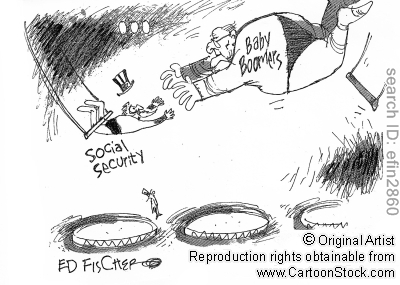 A report from the Insured Retirement Institute titled, “Boomer Expectations for Retirement 2016” is the newest to shine the light on lack of retirement savings among baby boomers in the United States. It revealed that out of about 76 million American baby boomers, approximately 35 million lack any retirement savings at all. And, according to the Insured Retirement Institute’s latest research, it could get worse for many Americans.
Some statistics from the report are:
- Only 24% of boomers are confident their savings will last them through retirement.
- Only 55% of this demographic reported having savings for retirement; nearly half of those had saved less than $100,000.
- Less than 40% have determined a savings goal.
- Just over a quarter are seeking help from a financial professional.
At this point, for many older workers who are nearing retirement, time is running out to save up. The younger baby boomers who are now in their mid-to-late 50s still have some time to build up their retirement savings with catch-up contributions to a retirement plan coupled with disciplined savings. However, with out-of-pocket medical costs estimated to be around $250,000 during our retirement years (in today’s dollars), the road to retirement is going to be very bumpy. And, with Social Security always in the sights of the federal government’s chopping block, workers need to take control of their futures with more urgency.

In terms of preparing for the future and confidence in that preparation, the study found that only 22% of those surveyed are doing a good job of preparing for their future expenses and only 27% are confident they can cover healthcare expenses in retirement. Regarding long-term care costs (such as assisted living or nursing home stays or extended in-home care), only 16% are confident they can cover long-term care costs.
Adding to the problem is expectations about Social Security income and how it will meet the individual’s financial needs in later years. Kevin McGarry, director of the Nationwide Retirement Institute at Nationwide, was quoted as saying that Social Security represents about 40% of a person’s income in retirement but nearly two-thirds of Americans file for benefits early, reducing their overall benefits.
Plan for a brighter, self-directed future
If you are someone who is comfortable making your own investment decisions, and understands certain alternative assets, including them in a self-directed IRA can help your retirement plan avoid being a complete bust. On the contrary, including nontraditional investments in a self-directed retirement plan can help you build a more eclectic and potentially more lucrative retirement portfolio.
If you already are investing in real estate, commodities, precious metals, private placements, or hedge funds (to name a few), you can include these in a self-directed retirement plan. With the stock market on a volatile streak and with unpredictable returns, savvy investors can give their retirement savings a serious boost through self-direction.
At Next Generation Trust Services, we not only administer these plans, we also provide investors with the education they need to make informed decisions about their self-directed investments. Download our white paper that explains the secrets of self-direction for more information and check out our Starter Kits for everything you need to know about opening an account. If you have any questions about self-directed investments, our helpful professionals are ready with the answers. Contact Next Generation Trust Services at 888.857.8058 or email Info@NextGenerationTrust.com for more information and put the boom back into your retirement plan!

Can You Retire Without a Pension? A Self-Directed Retirement Plan Could be Your Answer
For decades, American corporations had a great system in place: lifelong employment at one or two companies and a retirement supported financially by their employer-funded pension. In these defined benefit plans, the pension payments are calculated according to length of service, and salary earned at the time of retirement. The money used to fund the pensions was historically invested in the stock market and in bonds, earning plenty of interest.
However, in an effort to tighten their corporate bootstraps, companies have moved away from these plans in recent years towards 401(k) plans (retirement savings plans sponsored by an employer, in which workers contribute a portion of their paycheck. In these defined contribution plans, the employee contributions can be either pre-tax or post-tax, and in some cases employers match employee contributions to a certain limit.
The public sector is also struggling to maintain its pension plans, which are partially funded by employee contributions and taxpayer dollars. In Illinois, pension liabilities were underfunded by $111 billion as of December 2015. New Jerseyans will remember the fight Governor Christie had with the teacher’s union to cut the teachers’ pensions as a budget-balancing, cost-cutting measure for the state. Other unions are feeling the pension pinch; thousands of Teamster retirees from across the country rallied at the U.S. Capitol in mid-April 2106 to protest the proposed cuts to their pensions by the Central States, Southeast and Southwest Areas Pension Fund (CSPF).
Why Are Pensions Failing?
Americans have been taught into thinking that their pension was going to provide a stable and comfortable retirement. However, for many workers, that part of the American dream has become a financial nightmare. In fact, many economists estimate pensions to be underfunded by several trillion dollars at this point.
In an article for SchiffGold, Addison Quale analyzed why the pension system is failing. Here are a few reasons:
- Interest rates are too low – The banks aren’t paying high interest rates like they did a generation (or longer) ago. Rates used to be 5%, and it was easy for the fund to make 7% average yield by investing in bonds and equities. Today, the interest rates are less than 2%, which means underfunded pensions or tapping into riskier investments to yield 7%, which is almost unattainable.
- Stock market isn’t taking off – The boom period of the late 1990’s, where people made a lot of money by investing in the stock market, has yet to return. Many people are hesitant to take a gamble on the stock market.
- Cost of living has gone up, but the salaries aren’t increasing – Inflation is not showing up in many salaries. The middle class is dying, and many people are losing their jobs to cheaper labor or technology.
A Cure for the Pension Plan Blues — Self-Directed Retirement Plans
As recent history and events are showing us, the pension system is collapsing (not to mention, the Social Security Trust Fund, which may not pay benefits to millennial workers when they are ready to retire). However, Americans have options when it comes to saving for retirement. For those who are comfortable making their own investment decisions, and want to take full control of their financial future, a self-directed retirement plan could be a great way to go.
Rather than be beholden to an employer pension that may or may not be there when you retire, why not look into self-direction as a retirement wealth-building strategy? For individuals who know and understand how to invest in nontraditional assets, doing so through their retirement plan is a great way to build up a diverse portfolio beyond stocks, bonds, and mutual funds. And, it frees those investors from the burden of uncertain pension plan benefits.
Any kind of retirement plan can be self-directed: Traditional or Roth IRA, SIMPLE IRA, SEP IRA and, if your employer offers the option, a 401(k) plan (ask your employee plan administrator). Investors can include real estate, precious metals, commodities, unsecured loans, hedge funds and many more alternative assets within these plans.
At Next Generation Trust Services, we’re here to help. Our Starter Kits have everything you need to open an account and our educational videos walk you through the steps of many types of transactions. If you have any questions about self-directed investments or need help getting started, contact our helpful professionals at 888.857.8058 or Info@NextGenerationTrust.com.