SCALE: A Concrete Road Map to Work Less & Grow Your Business
Have you ever wanted your business to grow but held yourself back from fear that it would take over your life?
Join Wall Street Journal bestselling author and successful entrepreneur David Finkel and get a concrete road map to grow your business and get your life back!
Meet Your Presenter…
 Karen Augis is the Business Development Representative at Next Generation Services. If there’s one thing Karen enjoys, it’s talking to prospective clients. She has extensive experience as a sales professional in several industries (following a career in finance) and she loves cultivating productive business relationships. As our business development consultant Karen calls on prospective clients, identifies and develops relationships with strategic partners, and conducts educational presentations (in person and on the Web) about various aspects of self-direction. Karen has her bachelor’s degree in finance from Trenton State College (now TCNJ).
Meet Your Speaker…
 David Finkel is co-author of, SCALE: 7 Proven Principles to Grow Your Business and Get Your Life Back, and one of the nation’s most respected business thinkers. A Wall Street Journal and Business Weekbestselling author of over 11 books, he is the CEO of Maui Mastermind®(www.MauiMastermind.com) one of the world’s premier business coaching companies. David and the Maui Advisor team have built and sold over $2 billion of businesses. An ex-Olympic-level athlete turned business multi-millionaire, David is an American success story.
Staying Fit in Retirement Could Mean a Healthier IRA Future

An article on Bloomberg.com recently cited that Fidelity Investments has estimated a 65-year-old couple who retired in 2014 would need, on average, $220,000 to cover out-of-pocket medical costs over the course of their retirement. This figure assumed there is Medicare insurance but no (additional) retiree health-care insurance through a former employer.
(Add to that figure another $17,000 annually for every year that the couple is in retirement before age 65.)
This is just for medical expenses; what about daily living or paying for that long-awaited travel, indulging the grandkids or making sure you can live the way you’re accustomed to in those golden years?
PLAN FOR WORST-CASE SCENARIOS
Dal Watson, an insurance adviser and employee benefits consultant says he believes the $220,000 figure should be viewed as a minimum. “Since we don’t have a crystal ball, it’s prudent to plan for a more worst-case scenario. The total monthly costs for in-home care range from $4,000-5,000; nursing home care can range $4,000-6000 per month for a semi-private/double occupancy room, and $7,000 monthly and up for a private room. The more complicated the medical care situation, the greater the price.”
It seems that our health will take a huge chunk out of our retirement savings if we’re not careful. So how to plan now for a healthier future, both physically and financially?
BEING HEALTHY IN RETIREMENT COSTS LESS
Here’s another interesting note: In a recent nationwide survey by Schwab Retirement Plan Services, respondents said they’d rather see their 401(k) balance increase by 15 percent than lose 15 pounds this year. And about 35 percent of the 25-to-70-year-olds in the survey were unwilling to sacrifice their quality of life today (such as cutting down on dinners out or on vacations) to save more for retirement.
Well, many of us might not want to do less takeout or take a staycation, but it’s clear that taking care of ourselves and being healthier in retirement will cost us less in health care expenses—and give us a potentially better retirement lifestyle.
HEALTHY PEOPLE EARN MORE MONEY
For instance, committing to a regular exercise regimen has been shown to increase earnings. A 2011 study from Cleveland State University found that men who exercised three or more times a week had about a 6 percent earnings gain compared with men who didn’t. For women, the gap was about 10 percent. The reason for the earnings gap was not identified.
CONSIDER A HEALTH SAVINGS ACCOUNT FOR LONG-TERM FINANCIAL AND PHYSICAL HEALTH
Of course, the healthier we stay, the less we spend on medical bills and procedures. But another way to prepare for medical costs is to open a health savings account (HSA), which is available for people with high-deductible health insurance plans. The HSA will travel with you from job to job and you control how the money is spent.
“HSAs are excellent way to accumulate monies for long-term health conditions and/or disability needs, with tax-preferred benefits,” notes Watson. “If you think your health plan or Medicare supplement is going to get you very far down that road, you are kidding yourself. Ask anyone who has lived it first-hand.”
Even better, you can have a self-directed health savings account, with the potential to grow the fund more aggressively by investing in alternative assets.
Individuals can contribute up to $3,350 a year in a HSA. Adding to the financial health they can confer, these accounts are “triple tax-free.” You put pretax money in them, it grows tax-deferred, and you aren’t taxed on the money you use for medical reasons. After age 65, you can pull money out and use it for non-medical reasons, and pay regular income tax on it.
FIND OUT IF YOU QUALIFY FOR AN HSA
Dal Watson adds this final note: “Check with your tax professional for more information and how it affects you personally. If you have substantial assets, or cannot medically qualify for a long-term care policy, a self-directed plan is a great alternative.” (You can follow him on Twitter: @HealthReform411).
Whether it’s time to lose those extra pounds, start exercising, or take care of those medical issues that have been dogging you for years, it’s always a great time to open a self-directed health savings account for those who qualify. If you have any questions about self-direction as a retirement wealth-building strategy, we invite you to read our informative white paper. For questions about how to include nontraditional investments in your HSA to grow healthier retirement savings, contact Next Generation Trust’s helpful self-direction specialists at (888) 857-8058 or Info@NextGenerationTrust.com.
Small-Business Owners: Are You Planning Smartly for Business Continuity When you Retire?
 Business Ownership
 Business Ownership
Owning your own business is filled with rewards—and its share of stress and worries. For those who are running profitable businesses, there are as many things to consider in order to ensure a smooth hand-off of the business when it’s time to retire.
However, a study by MassMutual reveals that almost 40 percent of business owners don’t have a retirement income strategy, assuming that proceeds from selling their business will feather their retirement nests. This might not be the case, so small-business owners are wise to do some planning in advance.
Before you sit back and relax in your retirement years, here are some steps to take while you’re in business owner mode to protect you and your heirs.
Have your business appraised
Valuation is an important first step in determining what you might get for your company when you sell it. Hire an expert appraiser to ascertain what your business is worth; this information will also be important for you and your financial adviser(s) for estate and succession planning. Some online tools, such as the one from BizEquity, can give you an approximation as a planning starting point.
Plan for your business’ future after you leave
Unfortunately, retirement isn’t the only thing that can cause a change in business ownership; disability or death may also intervene. Planning for these scenarios is vital to the long-term health of the company you’ve worked so hard to build up. Who will step into leadership roles? How will that look? Two ways to do this are with buy-sell agreements and succession plans.
Buy-sell agreement
The MassMutual study showed that only 44 percent of business owners have buy-sell agreements that lay out contingency plans for retirement, disability, divorce, death, or personal bankruptcy (the issues that would cause business disruption for a small business). This legally binding contract is among company owners or between the owners and the company, and ensures business continuity if ownership changes. Buy-sell agreements can also be used for estate tax planning so be sure to consult your financial advisers about this important tool.
Having adequate insurance is also important to protect heirs during a buyout. The MassMutual Survey also found that only 52 percent of existing buy-sell agreements are funded with life insurance and only 5 percent are funded for a disability buyout.
Succession plan
This is all about transitioning ownership of the company (to your heirs or other internal stakeholders) during your lifetime or in the event of your death. It’s as much a human resource issue as it is a long-term financial strategy. Upon your death, your succession plan will make it easier for your family when your ownership intentions are clearly spelled out.
Build a robust retirement nest egg through self-direction
If you’re not only savvy about your area of enterprise but savvy about alternative asset investing as well, a self-directed SEP IRA can be a great way for you (and your employees) to build up retirement capital. All types of retirement plans may be self-directed (Traditional and Roth IRAs and even HSAs may be self-directed); you may also choose to offer a self-directed SIMPLE IRA to your employees, depending on your business goals.
These self-directed accounts allow individuals to include a broad array of nontraditional investments, such as real estate, precious metals, hedge funds, commodities and so much more—assets they already know and understand, and might be investing in outside of an existing IRA.
As part of your long-term business planning, you recommend you consult your tax or other financial adviser about setting up these retirement plans and determining if they’re right for you. At Next Generation Trust Services, we’re available to answer questions about the types of investments that may be included and help you get set up with ease. We have plenty of online tools available on our website, including a SEP IRA starter kit.
Get Our Free Whitepaper: the Secrets About Self-Directed Retirement Plans Your Broker Doesn’t Want You to Know!
Contact the helpful professionals at Next Generation Trust Services at (888) 857-8058 or Info@NextGenerationTrust.com today!
Crowdfunding Opens Up to a Wider Investing Crowd
Recent Rulings
Two things recently happened to give companies and investors something to celebrate in the arena of crowdfunding.
On October 30, 2015, the Security and Exchange Commission (SEC) passed Title III of the JOBS Act, approving new rules that allow companies to offer stock on crowdfunding platforms (until that time, crowdfunding sites such as Indiegogo and Kickstarter could only offer tangible swag items in exchange for capital; equity crowdfunding has been available on other sites for a while for accredited investors). This move now widens the investor pool for early-stage companies to include non-accredited investors, who previously had been barred from making equity investments. Non-accredited investors are individuals with a net worth of less than $1 million and an annual income of less than $200,000, who now have the opportunity to purchase securities.
These non-accredited investors may take advantage of the Internet platforms where startups may publicize their need for capital and the investment opportunities they present. And now, this new pool of investors can make equity investments and get shares in those early-stage businesses.
The SEC took some protective measures; new rules include:
- Limits set on how much and to what extent non-accredited investors can participate in a crowdfunding transaction, based on income percentages and net worth.
- A startup is permitted to raise up to $1 million through online equity crowdfunding from unaccredited investors in a 12-month period.
- For both accredited and non-accredited investors, the SEC put an aggregate annual ceiling on how much crowdfunding investment anybody could do in a given year (a maximum of $100,000 in startups in any given year).
There are also limits on the liquidity of the purchased securities; when an investor purchases stock in a crowdfunding transaction, the shares must be held for at least a year before they can be resold.
New Jersey Joins the Online Crowdfunding Portals
On November 9, New Jersey’s governor, Chris Christie also signed a bill into law that would allow private businesses to begin crowdfunding through web portals, in order to secure private investments of up to $1 million from state-based, unaccredited funding sources. Contributions will be capped at a maximum of $5,000 each. Similar bills have been passed in Kansas, Georgia, Wisconsin and North Carolina.
As with the SEC ruling, the new law would permit companies to offer investors shares of equity in return for their investments.
Add Investments in Startups in Your Self-Directed IRA
Gov. Mitt Romney showed us, during his presidential campaigns, that wealth can be built by including investments in early-stage companies in a self-directed retirement plan (a source of much of his wealth).
Now, the SEC has opened the door wider accredited and non-accredited investors to include equity funding in companies through your self-directed retirement plan. If you have a target company you’d like to help get off the ground by investing self-directed funds, you may do so. However, as with all alternative assets, we encourage our clients to fully research the target investment and fully understand it before sending us your instructions for the transaction.
And, as with all self-directed assets, all income and expenses related to the investment must flow through the retirement plan from which the investment was made.
As a third-party administrator of self-directed retirement plans, Next Generation Trust Services has all the documentation you need to get started. Our helpful professionals can answer your questions about self-directed investing in general, and can explain the transaction process for you. Read through our Starter Kits and other account management documents to get started.
Contact us with your questions at either Info@nextgenerationtrust.com or (888) 857-8058.
If crowdfunding is a new strategy to you, you can download our informative white paper for more background on this investment opportunity.
Don’t Let a Slow Economy Slow Down Your Self-Directed Retirement Savings

A Slow Economy
An article in Investment News has some sobering news forecasts for investors; it reported that some economists are predicting a period of slow growth for the foreseeable future. The U.S. Commerce Department estimates a decrease in gross domestic product in the third quarter as compared to the second quarter (by a lot—1.5% vs. 3.9% respectively). Goldman Sachs gave an even grumpier estimate of only 1%.
These figures are tied to the economic slowdown in China which is one of our country’s biggest export customers (this slows our productivity growth); Japan and Europe are also suffering weak economies which impact the U.S. in this age of global economy.
Our nation’s relatively slow population growth is also a contributing factor and it’s not just the U.S.; China and Japan also saw a drop in “replacement rate” or number of births per woman.
Some statistics cited were:
- The real GDP growth rate in the U.S. has been below par since 2011, when it was 1.6%.
- It was only 2.3% in 2012, 2.2% in 2013 and 2.4% in 2014.
- It did not top 2.4% until the second quarter of this year, when it shot up to 3.9% after registering only 0.6% in the first quarter.
- The average growth rate since 1948 has been 3.23% per year. Many economists expect the economy to struggle to top 2.5% a year for the next few years, especially if the Federal Reserve raises interest rates bit by bit over those years (this tactic generally serves to slow the rate of economic growth).
Quick economics lesson
If this is true, then investors will see significant impact on their investment portfolios if they are heavy in traditional assets. That’s because slow economic growth is correlated with slow stock market growth because corporate earnings can’t grow faster than the economy. This also negatively affects interest rates—bad news for retirees or those saving for retirement through traditional investment classes. After all, low rates and low equity returns can’t keep pace with living expenses or cost of living increases. This could also have a negative impact on Social Security benefits (no increase). And with Medicare contributions threatening to increase, it could all spell trouble for retirement nest eggs in the next few years.
Get on a retirement savings fast track
Don’t sit back and wait for your account balance to tumble or your investments to stall in neutral (or go in reverse!). Take control of your future and prepare for an alternative investment strategy with a self-directed retirement account. You can include many nontraditional investments that may not be as susceptible to market downturns or what’s happening in China.
Rather than lower your expectations about investment returns or cut back on lifestyle choices, consider opening a self-directed IRA and investing in real estate, commodities, precious metals and a slew of alternative assets these plans allow. Are you already investing in these assets outside of your existing retirement plan? If so, you’re well on your way to becoming a self-directed investor.
Determine your nontraditional investments that you want to include in your self-directed IRA, research them thoroughly, then check out our Starter Kits to see how easy it is to open a new account … and build a more eclectic retirement portfolio that isn’t dependent on what’s happening in the stock market, T-bills or mutual funds.
Have a question about self-direction as a retirement wealth-building strategy? Need some clarification about whether a particular asset is allowed or how to make a transaction?
Learn the Secrets of a Self-Directed IRA Your Broker Doesn’t Want You To Know
Transaction Processing Times for your Self-Directed Retirement Plan
How long does it take?
As your account administrator, Next Generation Trust Company wants to ensure that every “i” is dotted and every “t” is crossed when it comes to your application and account paperwork. Some of our clients have asked what this phase entails and how long it takes, so we offer this clarification of transaction processing times and our rigorous administrative review procedure.
This administrative review is the first phase of your transaction processing and is initiated when you send us your investing instructions. This review is required to make sure your desired transaction meets certain criteria, for a few very important reasons.
- Asset feasibility – we review the transaction to ascertain whether it is a) an asset you may reasonably include in your self-directed IRA and b) whether it is an asset we, as the account administrator, wish to hold.
- Compliance standards – it is our responsibility to make sure IRS guidelines are being followed regarding all self-directed investments based on the information we have from the client. We review each transaction and let our clients know if there is a possibility (or probability, in some cases) that it will be regarded as a prohibited transaction, or a transaction conducted with disqualified individuals.
- Protect the account’s tax-advantaged status – we want to make sure that, to the best of our knowledge, the transaction will not put your account’s tax-free or tax-deferred status at risk.
The administrative review will take between one and five business days, depending on the complexity of the transaction and our volume of transactions. Investment documents are processed in the order in which they are received. At the end of the review, we may require more complete documentation, corrections, and/or additional information to move ahead with the transaction processing.
Most transactions are completed in two business days provided that we have original, correct documents and cleared funding. For additional information, please check an earlier post that provides a good overview of the self-directed transaction process at Next Generation Trust Company.
We know you may be anxious to have your transaction processed but please understand, this is all for your protection!
If you have any additional questions regarding the administrative review process or executing your self-directed investment transaction, contact Next Generation at Info@NextGenerationTrust.com or (888) 857-8058.
Mind the Retirement Gap! – 2015
So you’re nearing retirement—or you’re still in the middle of your work life and saving regularly for your future. Are you going to be ready financially when you retire? Have you been investing in ways that will give you the right returns on those investments?
A new BlackRock survey on attitudes about money and financial goals found that:
 Americans are holding nearly twice as much cash as they think they ought to in order to reach their retirement goals.
- Fewer than 25% of them regularly set aside money into long-term savings or investment plans.
- The sting of the Great Recession might still be felt among many Americans, causing a gap between investor perception and reality. More than a third of Black Rock survey subjects said they were afraid of losing money–even though only 7% actually had lost money on a past investment.
- Nearly 40% of those surveyed said they want to make sure they have enough cash saved for emergencies before they save for retirement. Plus, the majority of respondents said difficulty paying their bills and saving for retirement at the same time.
- Regardless of these figures, 74% said they feel financially secure and “prepared to pursue their dreams.”
 Americans are holding nearly
 Chuck J. Rylant, MBA writes about personal finance and authored “How to be Rich: The Couple’s Guide to a Rich Life Without Worrying About Money.” He says that when it comes to saving for retirement, “Many do not invest enough because they are overwhelmed.” He suggests that individuals “begin with an honest assessment of how much you will need in retirement.” Then, as with starting any new habit (such as saving) Rylant recommends beginning with easy, achievable victories.
“To use a fitness example, if 100 pushups feels overwhelming, do one pushup per day. When one is easy, do two. Eventually 100 will seem easy. Money is no different.”
Expectations vs. reality for retirement income
The gap between expectations of future annual retirement income and present reality shows a yawning gap that reflects this disconnect. The survey respondents who are baby boomers (ages 55 to 64) said they expected to have about $45,000 in annual income when they retire; but the real figure based on what they had saved would only provide approximately $9,129 annually—a potential $36,371 gap!
This trend was even evident among affluent retirees (earning more than $250,000 a year) who also had not saved enough to generate the income they said they needed to meet their financial expectations during retirement.
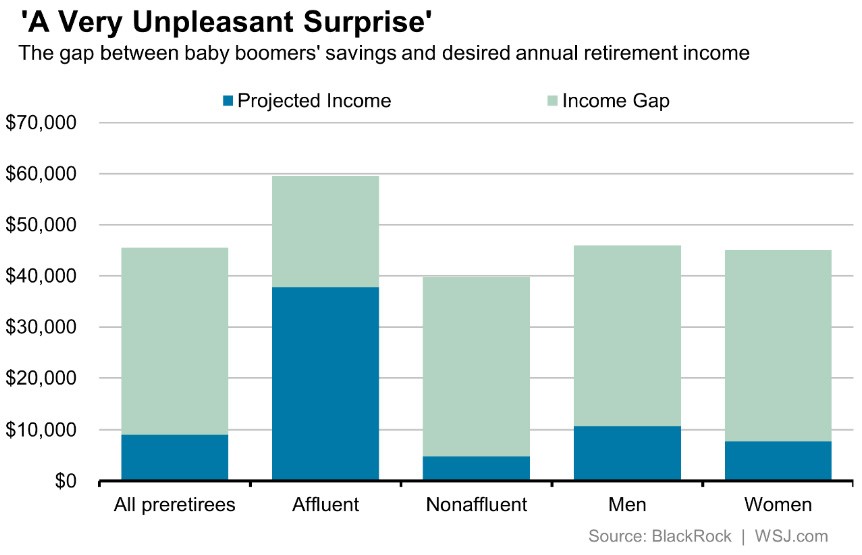
About that cash mentioned above: the very low interest rates don’t generate a lot of income, setting the stage for nasty surprises in later years (as the chart indicates is likely to happen).
The gap could widen for younger workers
The study also pointed out that millennials ages 25-34 were especially concerned about investing. Nearly half of this group in the Black Rock study agreed that “what you might earn investing isn’t worth the risk of losing your money,” the most of any other generation. This group had 70% of their portfolios in cash or cash-like investments.
While younger workers have plenty of employment years ahead of them, they might end up living even longer than senior citizens do today, and therefore spend a longer time in retirement—time that will require much more in savings.
Close the gap through self-direction
Whether you’re a millennial, a Gen-Xer or a baby boomer, it’s time to close the retirement gap between what you’ll need and what your retirement plan is prepared to pay you. A great way to do this for savvy investors is to open a self-directed retirement plan.
As we say at Next Generation Trust Services, if you are already investing in alternative assets outside of your existing IRA, why not use what you know and build up your savings through self-direction? Your experience with certain types of assets (such as real estate, precious metals, various commodities, unsecured loans and so much more) can help you bridge the retirement savings gap and meet your retirement income expectations.
Learn more about the types of investments you can include in a self-directed retirement plan, and go to our Starter Kits to get the ball rolling.
If you have any questions about self-direction as a retirement wealth building strategy, our knowledgeable professionals can address them and help get you on your way towards closing that retirement gap.
Contact us at Info@nextgenerationtrust.com or
(888) 857-8058 for more information.
How Investors Can Now Access Private Investments Online
Did You Know?
Did you know that start up private investments can be included in a self-directed retirement plan? View our encore presentation of How Investors Can Now Access Private Investments Online for more details.
Meet Your Presenter…
Karen Augis is the Business Development Representative at Next Generation Services. If there’s one thing Karen enjoys, it’s talking to prospective clients. She has extensive experience as a sales professional in several industries (following a career in finance) and she loves cultivating productive business relationships. As our business development consultant Karen calls on prospective clients, identifies and develops relationships with strategic partners, and conducts educational presentations (in person and on the Web) about various aspects of self-direction. Karen has her bachelor’s degree in finance from Trenton State College (now TCNJ).
Meet Your Speaker…
 Adam Sharp is the Founder of Early Investing a new website and e-letter focused on equity crowdfunding. He is an active investor in more than 20 startups, including Navdy, Upcounsel, Cabify, Faraday Bikes, Addy and Respondly. A former financial advisor, he also has extensive experience with Internet marketing and financial writing. Adam has worked as a marketing consultant for sites including chess.com and catalogs.com. He has built three profitable web businesses.
Bill Wittler is Moving on Up! Congratulations to our New Transaction Manager at Next Generation Trust Services
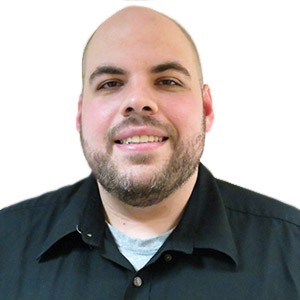 We are pleased to announce that Bill Wittler has been promoted to the position of transaction manager of Next Generation Trust Services. In this role, he will supervise our transaction team, maintain Next Generation’s compliance with regulatory issues within the self-directed retirement industry, and conduct administrative reviews of client transactions. Bill joined us a little over two years ago as a transaction supervisor; he had been responsible for ensuring accurate and efficient processing of all self-directed investments, and proper documentation and recording of all transactions (our transaction team will continue to manage those responsibilities).
Prior to joining Next Generation, Bill conducted property appraisals and research for a real estate appraisal firm, and he has extensive customer service, bookkeeping and cash management experience with a regional retailer. He is also a certified paralegal and holds a bachelor’s degree in criminal justice from Rutgers University.
“Bill has been a superb team member since he joined Next Generation, and he works well with both our staff and our clients, who often rely on our employees to guide them through their transactions,” said Jaime Raskulinecz, Next Generation’s CEO.
Congratulations, Bill, on a job well done—with more to come in the future!